esphome::sha256::SHA256 Class Referencefinal
SHA256 hash implementation. More...
#include <sha256.h>
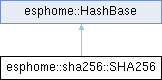
Inheritance diagram for esphome::sha256::SHA256:
Public Member Functions | |
| SHA256 ()=default | |
| ~SHA256 () override | |
| void | init () override |
| void | add (const uint8_t *data, size_t len) override |
| void | add (const std::string &data) |
| void | calculate () override |
| size_t | get_size () const override |
| Get the size of the hash in bytes (32 for SHA256) | |
| void | add (const char *data, size_t len) |
 Public Member Functions inherited from esphome::HashBase Public Member Functions inherited from esphome::HashBase | |
| virtual | ~HashBase ()=default |
| void | add (const char *data, size_t len) |
| void | get_bytes (uint8_t *output) |
| Retrieve the hash as bytes. | |
| void | get_hex (char *output) |
| Retrieve the hash as hex characters. Output buffer must hold get_size() * 2 + 1 bytes. | |
| bool | equals_bytes (const uint8_t *expected) |
| Compare the hash against a provided byte-encoded hash. | |
| bool | equals_hex (const char *expected) |
| Compare the hash against a provided hex-encoded hash. | |
Protected Attributes | |
| psa_hash_operation_t | op_ = PSA_HASH_OPERATION_INIT |
| mbedtls_sha256_context | ctx_ {} |
| br_sha256_context | ctx_ {} |
| bool | calculated_ {false} |
| EVP_MD_CTX * | ctx_ {nullptr} |
| Protected Attributes inherited from esphome::HashBase | |
| uint8_t | digest_ [32] |
Detailed Description
SHA256 hash implementation.
CRITICAL for ESP32 variants (except original) with IDF 5.5.x hardware SHA acceleration:
- The object MUST stay in the same stack frame (no passing to other functions)
- NO Variable Length Arrays (VLAs) in the same function
Note: Alignment is handled automatically via the HashBase::digest_ member.
Example usage: sha256::SHA256 hasher; hasher.init(); hasher.add(data, len); hasher.calculate();
Constructor & Destructor Documentation
◆ SHA256()
|
default |
◆ ~SHA256()
|
overridedefault |
Definition at line 17 of file sha256.cpp.
Member Function Documentation
◆ add() [1/3]
|
inline |
Definition at line 20 of file hash_base.h.
◆ add() [2/3]
|
inline |
◆ add() [3/3]
|
overridevirtual |
Implements esphome::HashBase.
Definition at line 25 of file sha256.cpp.
◆ calculate()
|
overridevirtual |
Implements esphome::HashBase.
Definition at line 27 of file sha256.cpp.
◆ get_size()
|
inlineoverridevirtual |
Get the size of the hash in bytes (32 for SHA256)
Implements esphome::HashBase.
◆ init()
|
overridevirtual |
Implements esphome::HashBase.
Definition at line 19 of file sha256.cpp.
Field Documentation
◆ calculated_
◆ ctx_ [1/3]
|
protected |
◆ ctx_ [2/3]
|
protected |
◆ ctx_ [3/3]
|
protected |
◆ op_
|
protected |
The documentation for this class was generated from the following files:
- esphome/components/sha256/sha256.h
- esphome/components/sha256/sha256.cpp
Generated by
 1.12.0