esphome::script::QueueingScript< Ts > Class Template Reference
A script type that queues new instances that are created. More...
#include <script.h>
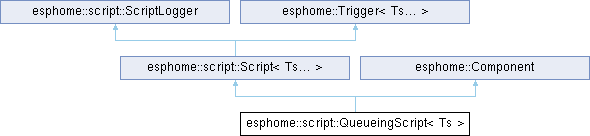
Inheritance diagram for esphome::script::QueueingScript< Ts >:
Public Member Functions | |
| void | execute (Ts... x) override |
| void | stop () override |
| void | loop () override |
| void | set_max_runs (int max_runs) |
 Public Member Functions inherited from esphome::script::Script< Ts... > Public Member Functions inherited from esphome::script::Script< Ts... > | |
| virtual bool | is_running () |
| Check if any instance of this script is currently running. | |
| void | execute_tuple (const std::tuple< Ts... > &tuple) |
| void | set_name (const LogString *name) |
| Public Member Functions inherited from esphome::Trigger< Ts... > | |
| void | trigger (const Ts &...x) ESPHOME_ALWAYS_INLINE |
| Inform the parent automation that the event has triggered. | |
| void | set_automation_parent (Automation< Ts... > *automation_parent) |
| void | stop_action () |
| Stop any action connected to this trigger. | |
| bool | is_action_running () |
| Returns true if any action connected to this trigger is running. | |
| Public Member Functions inherited from esphome::Component | |
| virtual void | setup () |
| Where the component's initialization should happen. | |
| virtual void | dump_config () |
| virtual float | get_setup_priority () const |
| priority of setup(). | |
| float | get_actual_setup_priority () const |
| void | set_setup_priority (float priority) |
| void | call () |
| virtual void | on_shutdown () |
| virtual void | on_safe_shutdown () |
| virtual bool | teardown () |
| Called during teardown to allow component to gracefully finish operations. | |
| virtual void | on_powerdown () |
| Called after teardown is complete to power down hardware. | |
| uint8_t | get_component_state () const |
| void | reset_to_construction_state () |
| Reset this component back to the construction state to allow setup to run again. | |
| bool | is_in_loop_state () const |
| Check if this component has completed setup and is in the loop state. | |
| bool | is_idle () const |
| Check if this component is idle. | |
| void | mark_failed () |
| Mark this component as failed. | |
| void | mark_failed (const LogString *message) |
| void | disable_loop () |
| Disable this component's loop. | |
| void | enable_loop () |
| Enable this component's loop. | |
| void | enable_loop_soon_any_context () |
| Thread and ISR-safe version of enable_loop() that can be called from any context. | |
| bool | is_failed () const |
| bool | is_ready () const |
| virtual bool | can_proceed () |
| bool | status_has_warning () const |
| bool | status_has_error () const |
| void | status_set_warning () |
| void | status_set_warning (const char *message) |
| void | status_set_warning (const LogString *message) |
| void | status_set_error () |
| void | status_set_error (const LogString *message) |
| void | status_clear_warning () |
| void | status_clear_error () |
| void | status_momentary_warning (const char *name, uint32_t length=5000) |
| Set warning status flag and automatically clear it after a timeout. | |
| void | status_momentary_error (const char *name, uint32_t length=5000) |
| Set error status flag and automatically clear it after a timeout. | |
| bool | has_overridden_loop () const |
| const LogString * | get_component_log_str () const ESPHOME_ALWAYS_INLINE |
| Get the integration where this component was declared as a LogString for logging. | |
| bool | should_warn_of_blocking (uint32_t blocking_time, uint32_t &threshold_ms_out) |
Protected Member Functions | |
| void | lazy_init_queue_ () |
| template<size_t... S> | |
| void | trigger_tuple_ (const std::tuple< Ts... > &tuple, std::index_sequence< S... >) |
| Protected Member Functions inherited from esphome::script::Script< Ts... > | |
| void | execute_tuple_ (const std::tuple< Ts... > &tuple, std::index_sequence< S... >) |
| void | run_actions_ (const Ts &...x) ESPHOME_ALWAYS_INLINE |
| Protected Member Functions inherited from esphome::script::ScriptLogger | |
| void | esp_logw_ (int line, const __FlashStringHelper *format, const char *param) |
| void | esp_logd_ (int line, const __FlashStringHelper *format, const char *param) |
| void | esp_log_ (int level, int line, const __FlashStringHelper *format, const char *param) |
| void | esp_logw_ (int line, const char *format, const char *param) |
| void | esp_logd_ (int line, const char *format, const char *param) |
| void | esp_log_ (int level, int line, const char *format, const char *param) |
| Protected Member Functions inherited from esphome::Component | |
| friend | void::setup () |
| friend | void::original_setup () |
| void | set_component_source_ (uint8_t index) |
| Set where this component was loaded from for some debug messages. | |
| virtual void | call_setup () |
| void | call_dump_config_ () |
| void | enable_loop_slow_path_ () |
| void | set_component_state_ (uint8_t state) |
| Helper to set component state (clears state bits and sets new state) | |
| bool | set_status_flag_ (uint8_t flag) |
| Helper to set a status LED flag on both this component and the app. | |
| void | set_interval (const char *name, uint32_t interval, std::function< void()> &&f) |
| Set an interval function with a const char* name. | |
| void | set_interval (uint32_t id, uint32_t interval, std::function< void()> &&f) |
| Set an interval function with a numeric ID (zero heap allocation). | |
| void | set_interval (InternalSchedulerID id, uint32_t interval, std::function< void()> &&f) |
| void | set_interval (uint32_t interval, std::function< void()> &&f) |
| bool | cancel_interval (const char *name) |
| Cancel an interval function. | |
| bool | cancel_interval (uint32_t id) |
| bool | cancel_interval (InternalSchedulerID id) |
| void | set_timeout (const char *name, uint32_t timeout, std::function< void()> &&f) |
| Set a timeout function with a const char* name. | |
| void | set_timeout (uint32_t id, uint32_t timeout, std::function< void()> &&f) |
| Set a timeout function with a numeric ID (zero heap allocation). | |
| void | set_timeout (InternalSchedulerID id, uint32_t timeout, std::function< void()> &&f) |
| void | set_timeout (uint32_t timeout, std::function< void()> &&f) |
| bool | cancel_timeout (const char *name) |
| Cancel a timeout function. | |
| bool | cancel_timeout (uint32_t id) |
| bool | cancel_timeout (InternalSchedulerID id) |
| void | defer (const char *name, std::function< void()> &&f) |
| Defer a callback to the next loop() call with a const char* name. | |
| void | defer (std::function< void()> &&f) |
| Defer a callback to the next loop() call. | |
| void | defer (uint32_t id, std::function< void()> &&f) |
| Defer a callback with a numeric ID (zero heap allocation) | |
| bool | cancel_defer (const char *name) |
| Cancel a defer callback using the specified name, name must not be empty. | |
| bool | cancel_defer (uint32_t id) |
| void | status_clear_warning_slow_path_ () |
| void | status_clear_error_slow_path_ () |
Protected Attributes | |
| int | num_queued_ = 0 |
| int | max_runs_ = 0 |
| size_t | queue_front_ = 0 |
| std::unique_ptr< std::unique_ptr< std::tuple< Ts... > >[]> | var_queue_ |
| Protected Attributes inherited from esphome::script::Script< Ts... > | |
| const LogString * | name_ |
| Protected Attributes inherited from esphome::Trigger< Ts... > | |
| Automation< Ts... > * | automation_parent_ |
| Protected Attributes inherited from esphome::Component | |
| uint8_t | component_source_index_ {0} |
| Index into component source PROGMEM lookup table (0 = not set) | |
| uint8_t | warn_if_blocking_over_ {WARN_IF_BLOCKING_OVER_CS} |
| Warn threshold in centiseconds (max 2550ms) | |
| uint8_t | component_state_ {0x00} |
| State of this component - each bit has a purpose: Bits 0-2: Component state (0x00=CONSTRUCTION, 0x01=SETUP, 0x02=LOOP, 0x03=FAILED, 0x04=LOOP_DONE) Bit 3: STATUS_LED_WARNING Bit 4: STATUS_LED_ERROR Bit 5: Has overridden loop() (set at registration time) Bits 6-7: Unused - reserved for future expansion. | |
| volatile bool | pending_enable_loop_ {false} |
| ISR-safe flag for enable_loop_soon_any_context. | |
| ComponentRuntimeStats | runtime_stats_ |
Detailed Description
template<typename... Ts>
class esphome::script::QueueingScript< Ts >
class esphome::script::QueueingScript< Ts >
A script type that queues new instances that are created.
Only one instance of the script can be active at a time.
Ring buffer implementation:
- num_queued_ tracks the number of queued (waiting) instances, NOT including the currently running one
- queue_front_ points to the next item to execute (read position)
- Buffer size is max_runs_ - 1 (max total instances minus the running one)
- Write position is calculated as: (queue_front_ + num_queued_) % (max_runs_ - 1)
- When an item finishes, queue_front_ advances: (queue_front_ + 1) % (max_runs_ - 1)
- First execute() runs immediately without queuing (num_queued_ stays 0)
- Subsequent executes while running are queued starting at position 0
- Maximum total instances = max_runs_ (includes 1 running + (max_runs_ - 1) queued)
Member Function Documentation
◆ execute()
template<typename... Ts>
|
inlineoverridevirtual |
Implements esphome::script::Script< Ts... >.
◆ lazy_init_queue_()
template<typename... Ts>
|
inlineprotected |
◆ loop()
template<typename... Ts>
|
inlineoverridevirtual |
Reimplemented from esphome::Component.
◆ set_max_runs()
template<typename... Ts>
|
inline |
◆ stop()
template<typename... Ts>
|
inlineoverridevirtual |
Reimplemented from esphome::script::Script< Ts... >.
◆ trigger_tuple_()
template<typename... Ts>
template<size_t... S>
|
inlineprotected |
Field Documentation
◆ max_runs_
template<typename... Ts>
|
protected |
◆ num_queued_
template<typename... Ts>
|
protected |
◆ queue_front_
template<typename... Ts>
|
protected |
◆ var_queue_
template<typename... Ts>
|
protected |
The documentation for this class was generated from the following file:
- esphome/components/script/script.h
Generated by
 1.12.0