Base class for all valve devices. More...
#include <valve.h>
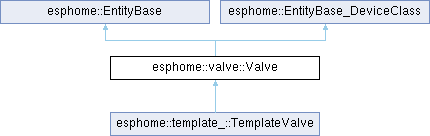
Public Member Functions | |
| Valve () | |
| ValveCall | make_call () |
| Construct a new valve call used to control the valve. | |
| template<typename F > | |
| void | add_on_state_callback (F &&f) |
| void | publish_state (bool save=true) |
| Publish the current state of the valve. | |
| virtual ValveTraits | get_traits ()=0 |
| bool | is_fully_open () const |
| Helper method to check if the valve is fully open. Equivalent to comparing .position against 1.0. | |
| bool | is_fully_closed () const |
| Helper method to check if the valve is fully closed. Equivalent to comparing .position against 0.0. | |
 Public Member Functions inherited from esphome::EntityBase Public Member Functions inherited from esphome::EntityBase | |
| const StringRef & | get_name () const |
| bool | has_own_name () const |
| uint32_t | get_object_id_hash () const |
| StringRef | get_object_id_to (std::span< char, OBJECT_ID_MAX_LEN > buf) const |
| Get object_id with zero heap allocation For static case: returns StringRef to internal storage (buffer unused) For dynamic case: formats into buffer and returns StringRef to buffer. | |
| size_t | write_object_id_to (char *buf, size_t buf_size) const |
| Write object_id directly to buffer, returns length written (excluding null) Useful for building compound strings without intermediate buffer. | |
| bool | is_internal () const |
| void | set_internal (bool internal) |
| bool | is_disabled_by_default () const |
| EntityCategory | get_entity_category () const |
| const char * | get_device_class_to (std::span< char, MAX_DEVICE_CLASS_LENGTH > buffer) const |
| StringRef | get_unit_of_measurement_ref () const |
| const char * | get_icon_to (std::span< char, MAX_ICON_LENGTH > buffer) const |
| uint32_t | get_device_id () const |
| Device * | get_device () const |
| bool | has_state () const |
| void | set_has_state (bool state) |
| ESPDEPRECATED ("Use make_entity_preference<T>() instead, or preferences won't be migrated. " "See https://github.com/esphome/backlog/issues/85. Will be removed in 2027.1.0.", "2026.7.0") uint32_t get_preference_hash() | |
| Get a unique hash for storing preferences/settings for this entity. | |
| template<typename T > | |
| ESPPreferenceObject | make_entity_preference (uint32_t version=0) |
| Create a preference object for storing this entity's state/settings. | |
Data Fields | |
| ValveOperation | current_operation {VALVE_OPERATION_IDLE} |
| The current operation of the valve (idle, opening, closing). | |
| float | position |
| The position of the valve from 0.0 (fully closed) to 1.0 (fully open). | |
Protected Member Functions | |
| virtual void | control (const ValveCall &call)=0 |
| optional< ValveRestoreState > | restore_state_ () |
| Protected Member Functions inherited from esphome::EntityBase | |
| friend | void::setup () |
| friend | void::original_setup () |
| void | configure_entity_ (const char *name, uint32_t object_id_hash, uint32_t entity_fields) |
| Combined entity setup from codegen: set name, object_id hash, entity string indices, and flags. | |
| void | set_device_ (Device *device) |
| ESPPreferenceObject | make_entity_preference_ (size_t size, uint32_t version) |
| Non-template helper for make_entity_preference() to avoid code bloat. | |
| void | calc_object_id_ () |
Protected Attributes | |
| friend | ValveCall |
| LazyCallbackManager< void()> | state_callback_ {} |
| ESPPreferenceObject | rtc_ |
| Protected Attributes inherited from esphome::EntityBase | |
| StringRef | name_ |
| uint32_t | object_id_hash_ {} |
| Device * | device_ {} |
| struct esphome::EntityBase::EntityFlags | flags_ |
| uint8_t | device_class_idx_ {} |
| uint8_t | uom_idx_ {} |
| uint8_t | icon_idx_ {} |
Detailed Description
Base class for all valve devices.
Valves currently have three properties:
- position - The current position of the valve from 0.0 (fully closed) to 1.0 (fully open). For valves with only binary OPEN/CLOSED position this will always be either 0.0 or 1.0
- current_operation - The operation the valve is currently performing, this can be one of IDLE, OPENING and CLOSING.
For users: All valve operations must be performed over the .make_call() interface. To command a valve, use .make_call() to create a call object, set all properties you wish to set, and activate the command with .perform(). For reading out the current values of the valve, use the public .position, etc. properties (these are read-only for users)
For integrations: Integrations must implement two methods: control() and get_traits(). Control will be called with the arguments supplied by the user and should be used to control all values of the valve. Also implement get_traits() to return what operations the valve supports.
Constructor & Destructor Documentation
◆ Valve()
Member Function Documentation
◆ add_on_state_callback()
|
inline |
◆ control()
|
protectedpure virtual |
Implemented in esphome::demo::DemoValve, and esphome::template_::TemplateValve.
◆ get_traits()
|
pure virtual |
Implemented in esphome::demo::DemoValve, and esphome::template_::TemplateValve.
◆ is_fully_closed()
|
inline |
◆ is_fully_open()
|
inline |
◆ make_call()
|
inline |
◆ publish_state()
| void esphome::valve::Valve::publish_state | ( | bool | save = true | ) |
◆ restore_state_()
|
protected |
Field Documentation
◆ current_operation
| ValveOperation esphome::valve::Valve::current_operation {VALVE_OPERATION_IDLE} |
◆ position
| float esphome::valve::Valve::position |
◆ rtc_
|
protected |
◆ state_callback_
|
protected |
◆ ValveCall
The documentation for this class was generated from the following files:
Generated by
 1.12.0